نوع مقاله : مقاله پژوهشی
عنوان مقاله English
نویسندگان English
1. Introduction
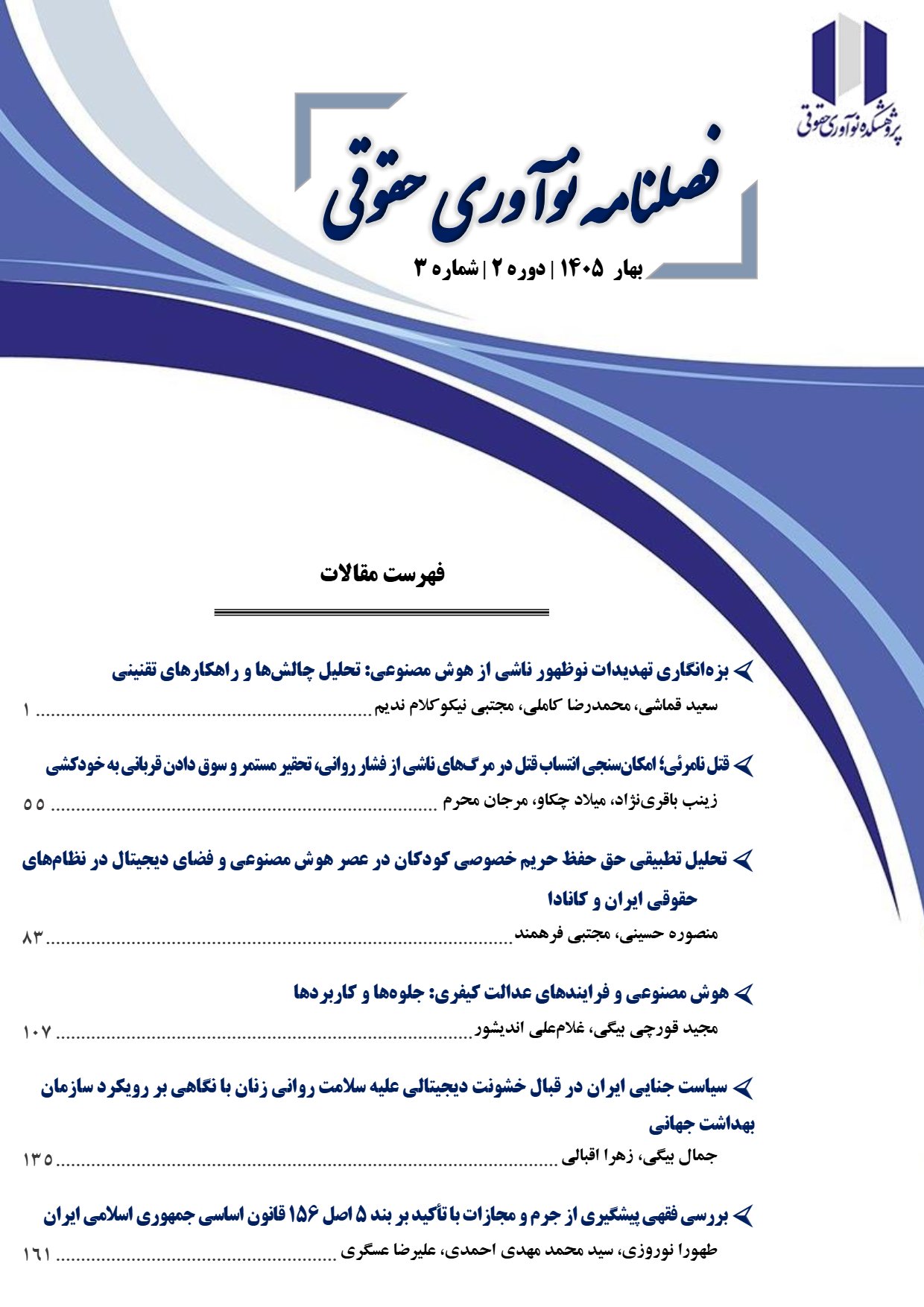
The article, “A Jurisprudential Examination of Crime Prevention and Punishment, with Emphasis on Clause 5 of Article 156 of the Constitution of the Islamic Republic of Iran,” examines the place of crime prevention from the perspective of Islamic jurisprudence and Iranian constitutional law.
2. Research Methodology
In the first section, the concept of crime prevention is explained, and its types, including social, situational, and penal prevention, are introduced. The article explains that social prevention serves to mitigate the conditions conducive to crime by improving cultural, economic, educational, and family conditions, whereas situational prevention prevents the commission of offenses by making opportunities to commit crimes more difficult to exploit and increasing the likelihood of their detection. Penal prevention is likewise pursued through legal sanctions and the proper enforcement of punishments.
The jurisprudential foundations of crime prevention are then examined. By drawing on the Qur’an, the Sunnah, the principle of enjoining good and forbidding wrong, social responsibility, the moral reform of individuals, and religious education, the author demonstrates that, in Islamic jurisprudence, prevention is better than cure. From the perspective of Islam, reducing crime is not possible through punishment alone; rather, the moral reform of individuals, the strengthening of faith, the promotion of social justice, and public responsibility play a fundamental role in prevention.
The role of social institutions, such as the family, education, culture, and society, in crime prevention is then analyzed. The article emphasizes that the family is the first institution of upbringing, and that the proper teaching of moral values, the strengthening of religious beliefs, and the creation of a healthy social environment are considered among the most important factors in reducing criminality.
3. Research Findings
A substantial section of the article is devoted to the analysis of Clause 5 of Article 156 of the Constitution. Under this clause, one of the duties of the Judiciary is “taking appropriate measures to prevent the commission of crime and to reform offenders.” By examining this constitutional provision, the author states that the Constitution does not regard prevention merely as an executive measure; rather, it considers prevention a fundamental duty of the Judiciary. It is also emphasized that achieving this objective requires cooperation from the country’s other executive, cultural, and social institutions, and that the Judiciary will not be able to fully implement preventive policies on its own.
The article then compares the jurisprudential foundations with Clause 5 of Article 156 and concludes that there is a considerable degree of consistency between Islamic teachings and the Constitution of the Islamic Republic of Iran. Principles such as the moral reform of individuals, justice, social responsibility, and crime prevention are emphasized in both jurisprudential sources and the Constitution. Accordingly, the criminal policy of the Islamic Republic of Iran rests on a solid jurisprudential foundation.
4. Recommendations
Finally, the author refers to the challenges involved in implementing preventive policy, including the lack of coordination among institutions, inadequate planning, a shortage of implementation mechanisms, cultural and social problems, and limited resources.
5. Conclusion
The article concludes that the effective realization of Clause 5 of Article 156 is possible only through cooperation among the Judiciary, the Government, and cultural and educational institutions, together with public participation, and that the development of preventive policies may have a significant impact on reducing crime, enhancing social security, and achieving justice.
کلیدواژهها English